When sourcing timber for construction, furniture, packaging, or woodworking, understanding sawn timber sizes is essential. Timber is commonly specified by thickness, width, and length, but actual dimensions can vary depending on the sawing method, moisture content, species, and allowable tolerance.
For buyers and importers, knowing how these dimensions are measured helps avoid specification errors and ensures the timber is suitable for further processing or its intended application. For a broader overview of timber types, grades, sizes, and applications, see our Sawn Timber: Types, Grades, Sizes, Uses & Buying Guide.
What Are Sawn Timber Sizes?
Sawn timber sizes refer to the basic dimensions of Wood Sawn Timber after logs have been cut into boards, planks, beams, or other sections. The three main dimensions are thickness, width, and length.
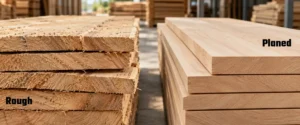
Unlike planed timber, rough sawn timber normally retains the textured surface created during sawing. Therefore, its dimensions are usually specified before further machining.
Common units include millimeters, centimeters, and meters. In international timber trade, buyers should confirm the unit and measurement method before placing an order.
Sawn Timber Thickness
Thickness is the distance between the two broad faces of a piece of timber. It is one of the most important sawn timber dimensions because it affects strength, weight, machining allowance, and final product dimensions.
Common thicknesses may include 20 mm, 25 mm, 30 mm, 40 mm, 50 mm, and thicker sections for structural or heavy-duty applications. However, available sizes depend on the timber species, mill equipment, and intended use.
Rough sawn timber may be supplied slightly thicker than the final required dimension. This allows buyers to plane or machine the material later. For example, a buyer requiring a finished thickness of 20 mm may specify a larger rough sawn thickness to provide sufficient machining allowance.
Sawn Timber Width
Width is measured across the face of the board. Depending on the product and cutting method, timber may be supplied in fixed widths or variable widths.
Common commercial widths can range from narrow boards to wide planks. Construction timber often uses standardized dimensions, while furniture and woodworking projects may require wider or specially selected boards.
Width can also be affected by natural characteristics such as knots, growth patterns, and edge defects. For this reason, buyers should clarify whether the quoted width is a fixed dimension, average dimension, or minimum usable width.
When purchasing timber in large quantities, consistent width can simplify downstream processing and improve production efficiency.
Sawn Timber Length
Length is measured from one end of the timber to the other. Sawn timber can be supplied in fixed lengths or mixed lengths, depending on the supplier and application.
Typical commercial lengths may include 2.0 m, 2.4 m, 3.0 m, 3.6 m, 4.0 m, and longer sections. Custom lengths may also be available for specific projects.
For construction and packaging, standard lengths can make cutting and production planning easier. Furniture manufacturers may prefer longer timber because it provides more flexibility when cutting components.
Buyers should also confirm whether the quoted length is an exact dimension or falls within an agreed length range.
Understanding Sawn Timber Tolerances
A key consideration when checking sawn timber sizes is dimensional tolerance. Tolerance refers to the acceptable difference between the specified size and the actual measured size.
For example, if a timber specification states 50 mm thickness with a tolerance of ±2 mm, the actual thickness may fall between 48 mm and 52 mm.
Tolerance can vary according to the timber grade, product type, moisture condition, processing method, and applicable standard. Rough sawn timber generally has more dimensional variation than planed timber because its surfaces have not undergone final machining.
For international orders, buyers should agree on tolerances before production. This is particularly important when timber will be processed into components with tight dimensional requirements.
What Affects Sawn Timber Dimensions?
Several factors can influence actual timber dimensions.
Moisture content is one of the most important. Timber can shrink or expand as its moisture content changes. The degree of dimensional movement depends on the species and the direction of the wood grain.
Sawing accuracy also affects dimensions. Different cutting equipment and production methods can result in different levels of dimensional consistency.
Timber species matters as well. Hardwood and softwood species have different density, grain structures, and shrinkage characteristics. For more information, see our guide to Hardwood vs Softwood Sawn Timber.
Finally, storage and transportation conditions can influence timber after production. Proper storage helps reduce unnecessary moisture changes and dimensional movement.
How to Specify Sawn Timber Sizes When Buying
When requesting a quotation, buyers should provide complete dimensional information rather than only stating the product name.
- Thickness
- Width
- Length
- Timber species
- Grade
- Moisture content
- Surface condition
- Dimensional tolerance
- Quantity or volume
- Applicable quality standard
For example, a purchase specification could state: rough sawn timber, 50 × 100 mm, 3.0 m length, with an agreed dimensional tolerance and specified moisture range.
This level of detail helps suppliers understand the exact requirement and reduces the risk of receiving material that cannot be used efficiently.
Choosing the Right Sawn Timber Dimensions
The right dimensions depend on the intended application. Construction projects may prioritize structural requirements and dimensional consistency. Furniture production may focus on width, appearance, and machining allowance. Packaging manufacturers may prioritize efficient cutting and stable supply.
Buyers should also consider whether the timber will be used as rough material or processed into a finished product. If further planing, trimming, or cutting is required, sufficient machining allowance should be included in the original specification.
To understand how surface processing can affect the final dimensions and appearance, see our guide to Planed vs Rough Sawn Timber.
Conclusion
Understanding sawn timber sizes helps buyers make more accurate purchasing decisions and communicate specifications clearly with suppliers. Thickness, width, length, and dimensional tolerance all influence how timber performs during processing and in its final application.
Before ordering, confirm the timber species, grade, moisture content, dimensions, tolerance, and measurement method. For projects with specific requirements, working with an experienced Wood Sawn Timber supplier can also help ensure consistent specifications and reliable supply.
If you are sourcing sawn timber for construction, furniture, packaging, or other applications, contact us to discuss your required species, dimensions, grades, and order specifications.