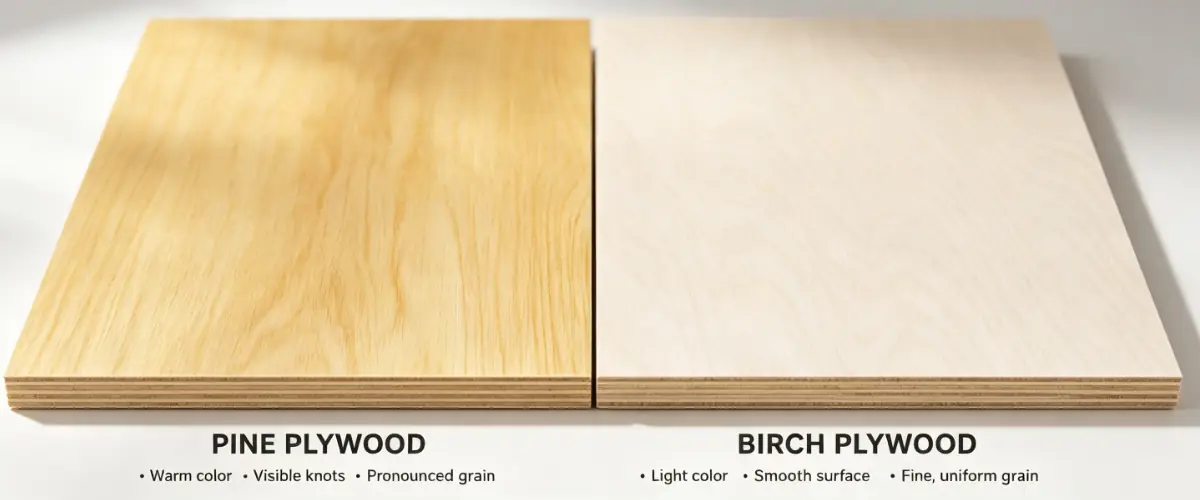
Choosing between pine plywood vs birch plywood is not always as simple as picking the stronger or cheaper panel. Both materials are widely used, but they perform differently in furniture, construction, shelving, cabinetry, and interior projects.
If you are sourcing plywood for a project, the better choice depends on what matters most: strength, surface appearance, weight, workability, budget, or end use. In general, pine plywood is a practical option for construction and budget-conscious projects, while birch plywood is often preferred for furniture, cabinetry, CNC work, and applications where a clean finish matters.
Pine Plywood vs Birch Plywood: Key Differences
The biggest difference comes from the wood species used to make the veneers. Pine is a softwood, while birch is a hardwood. This affects the finished plywood’s hardness, appearance, machining behavior, and typical applications.
| Feature | Pine Plywood | Birch Plywood |
|---|---|---|
| Wood type | Softwood | Hardwood |
| Surface | Visible grain and knots | Fine and uniform grain |
| Weight | Usually lighter | Usually heavier |
| Hardness | Softer | Harder |
| Appearance | Rustic and natural | Smooth and clean |
| Workability | Easy to cut | Excellent for precision work |
| Typical use | Construction and utility projects | Furniture and cabinetry |
| Cost | Usually more affordable | Usually higher |
However, plywood quality varies by grade, core construction, adhesive, thickness, and manufacturer. So species alone should not be the only factor when comparing panels.
Strength: Is Birch Plywood Stronger Than Pine?
For many furniture and precision applications, birch plywood has an advantage because birch veneers are dense and hard. A well-made all-birch panel can provide excellent bending strength, dimensional stability, and screw-holding performance.
Pine plywood can also be strong, especially when you choose a structural-grade product designed for construction. This is an important distinction: structural pine plywood and furniture-grade birch plywood are often made for different jobs.
For roof decking, wall sheathing, subfloors, and other structural applications, the panel’s structural rating and applicable building standard are more important than simply choosing birch over pine.
For furniture, shelving, cabinets, and CNC-machined parts, birch plywood is often the safer choice when you need a hard, stable, and consistent panel.
Appearance and Surface Finish
This is where the difference between pine and birch plywood becomes easy to see.
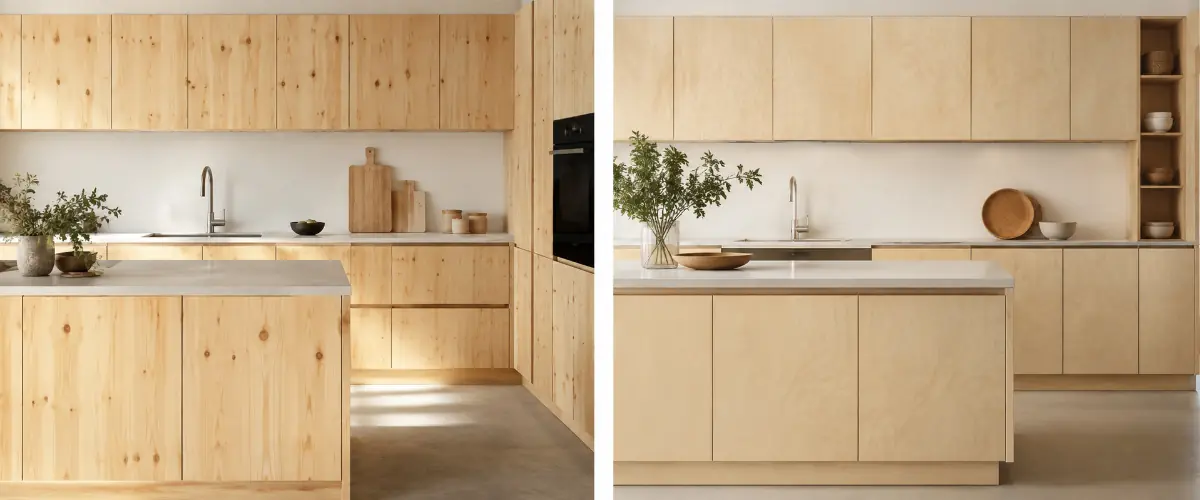
Pine plywood usually has a more noticeable grain pattern and may contain knots, depending on the face grade. This gives it a warm, natural appearance that works well for rustic furniture, workshops, shelving, and decorative projects.
Birch plywood has a finer and more uniform grain. Higher face grades provide a clean surface that is easy to sand, paint, stain, laminate, or finish.
If you are making modern cabinets, office furniture, drawers, or other products where the plywood surface will remain visible, birch is usually the better fit.
For more information about grades, construction, applications, and buying considerations, see our [Birch Plywood Complete Guide].

Which Is Better for Furniture?
For most furniture projects, birch plywood is the stronger overall choice.
Its smooth surface gives furniture a more refined appearance, while its dense veneer structure works well for screws, fasteners, CNC routing, and repeated machining.
Birch plywood is particularly suitable for:
- Kitchen cabinets
- Wardrobes and storage units
- Drawer boxes
- Bookshelves
- Desks and tables
- Office furniture
- CNC-cut furniture parts
That does not mean pine plywood cannot be used for furniture. Pine can be a good option for rustic furniture, simple shelving, workbenches, and projects where a lower material cost is important.
Which Is Better for Construction?
For construction, pine plywood can be the more practical option, especially when a structural grade is required.
Pine plywood is commonly used for applications such as:
- Wall sheathing
- Roof decking
- Subfloors
- Temporary structures
- Packaging and crates
- General building projects
The key point is to select plywood that meets the structural requirements of your project. A furniture-grade birch panel should not automatically be substituted for a certified structural plywood simply because it has a higher-density wood species.
Which One Is More Affordable?
In many markets, pine plywood costs less than birch plywood. Pine is therefore attractive for large-volume construction, utility projects, packaging, and other applications where appearance is not the main concern.
Birch plywood usually costs more because buyers are paying for its surface quality, density, consistent veneer structure, and machining performance.
For a large project, however, the cheapest sheet is not always the most economical choice. Consider cutting waste, finishing requirements, durability, and the expected service life before making the final decision.
Pine Plywood or Birch Plywood: Which Should You Choose?
There is no single winner in the pine plywood vs birch plywood comparison.
Choose pine plywood if you need:
- A cost-effective panel
- A lightweight softwood plywood
- Construction or utility panels
- Rustic or natural-looking surfaces
- Material for large-volume projects
Choose birch plywood if you need:
- A smooth, attractive surface
- Higher hardness and durability
- Reliable CNC machining
- Furniture or cabinet components
- Strong screw-holding performance
- A clean painted or natural finish
The most important step is to match the plywood specification to the actual application. Thickness, grade, core construction, adhesive, moisture resistance, and certification can all affect the final performance.
Conclusion
Choosing between pine plywood vs birch plywood depends on your project requirements, budget, and expected performance. Pine plywood is a practical option for construction, packaging, shelving, and general-purpose applications, while birch plywood is better suited to furniture, cabinetry, CNC machining, and projects that require a smooth, consistent appearance.
For bulk plywood purchasing, the right specification is just as important as the wood species. Before placing an order, confirm the plywood thickness, grade, core construction, glue type, surface finish, size, and required certifications with your supplier. These factors can directly affect panel performance, processing, and overall project results.
If you are looking for a reliable plywood supplier for your construction or furniture project, contact our team to discuss your requirements. We can help you select the right plywood type and specifications based on your application, order quantity, and target market.