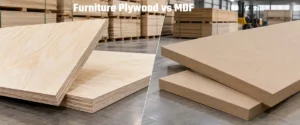
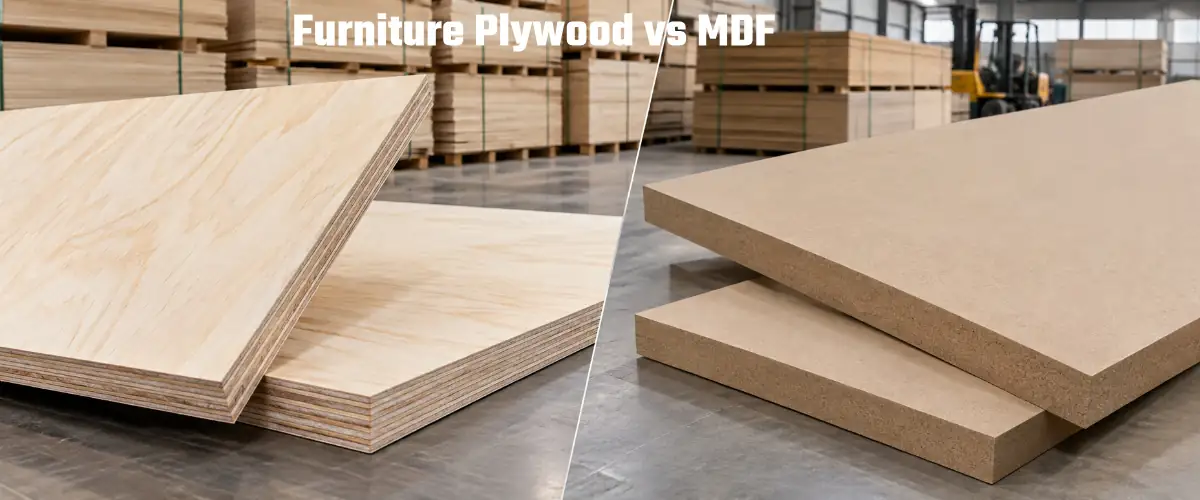
Choosing the right panel material is an important decision for furniture manufacturers, cabinet makers, and B2B buyers. Furniture plywood vs MDF is a common comparison because both materials are widely used for cabinets, shelving, wardrobes, tables, doors, and other interior furniture components. However, their construction, strength, surface characteristics, and machining performance are different.
Furniture plywood is made from multiple layers of wood veneer bonded together, while MDF is manufactured from refined wood fibers combined with resin under heat and pressure. The better option depends on the furniture application, required performance, finishing method, and production process.
What Is Furniture Plywood?
Furniture plywood is a multilayer wood panel made by bonding thin veneer layers together, usually with the grain direction alternating between layers. This cross-laminated construction gives plywood a strong and stable structure.
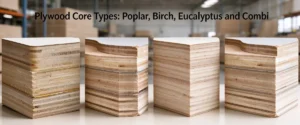
Depending on the application, furniture plywood can use different wood species and core constructions. Birch plywood, poplar plywood, hardwood plywood, and other plywood types are commonly used for furniture manufacturing.
For buyers looking for a broader overview of furniture-grade panels, our Plywood Buying Guide explains the main factors to consider when selecting plywood for different applications.
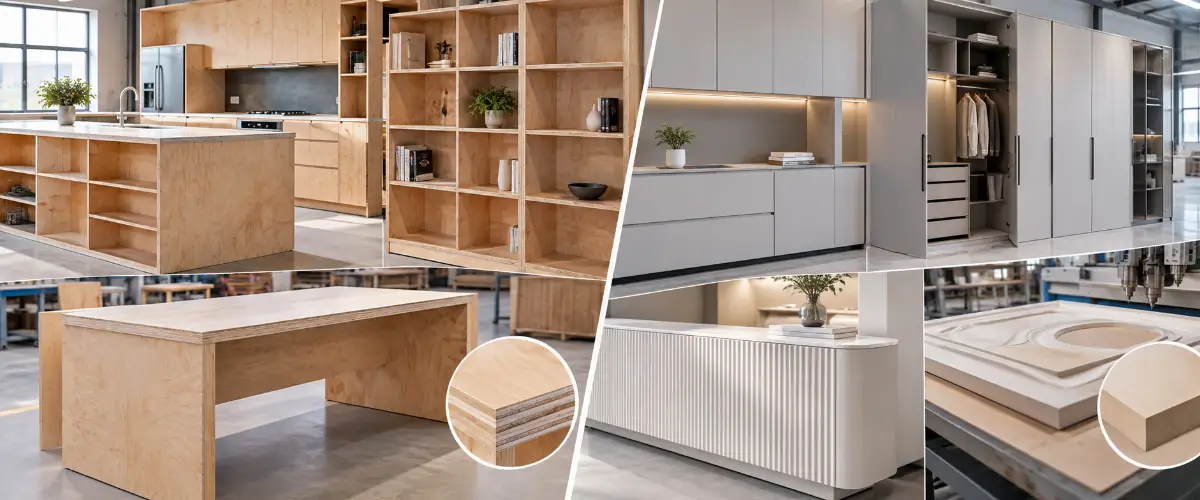
Furniture plywood is commonly used for:
- Kitchen cabinets
- Shelving
- Tables and desks
- Wardrobes
- Storage furniture
- Furniture frames
- Interior components
For decorative furniture, buyers can also consider Fancy Plywood for Furniture, especially when the surface appearance and natural wood effect are important.
What Is MDF?
MDF, or medium-density fiberboard, is produced by breaking wood into fibers and combining them with resin before pressing the material into uniform panels. Unlike plywood, MDF does not contain cross-laminated veneer layers.
One of MDF’s main advantages is its smooth and consistent surface. This makes it suitable for painting, laminating, routing, and other finishing processes.
For a more detailed explanation of MDF construction, characteristics, and applications, see our guide to What Is MDF Board? Complete Guide for Buyers.
MDF is commonly used for:
- Painted cabinet doors
- Wardrobe components
- Decorative furniture
- Shelves
- Interior panels
- CNC-machined furniture parts
Furniture Plywood vs MDF: Key Differences
The main differences between furniture plywood and MDF come from their construction and physical properties.
| Factor | Furniture Plywood | MDF |
|---|---|---|
| Construction | Cross-laminated wood veneers | Compressed wood fibers |
| Strength | Generally higher | Moderate |
| Surface | Natural wood grain or veneer finish | Smooth and uniform |
| Screw holding | Generally strong | Suitable for many applications |
| Moisture performance | Depends on grade and glue | Depends strongly on MDF grade |
| Weight | Often lighter for comparable applications | Often relatively heavy |
| Painting | Good | Excellent |
| CNC machining | Good | Excellent |
| Natural wood appearance | Available | Requires veneer or decorative finish |
| Typical use | Structural and demanding furniture components | Smooth, painted, and decorative components |
These differences do not mean that one material is always better. The right choice depends on what the furniture component needs to do.
Strength and Durability
For furniture components that require good structural strength, furniture plywood is often a strong choice. Its layered construction distributes loads across the panel and provides good resistance to bending and mechanical stress.
This can be particularly useful for shelving, cabinet structures, tables, and other components that need to support weight.
MDF provides sufficient strength for many interior furniture applications, but its performance depends on density, thickness, and panel grade. It is often selected where a smooth and uniform surface is more important than maximum structural performance.
Moisture Resistance
Moisture performance is another important consideration when comparing furniture plywood and MDF.
Suitable plywood grades can provide good resistance to changes in humidity, particularly when the correct glue type, veneer construction, and surface treatment are specified. However, not all plywood has the same moisture performance.
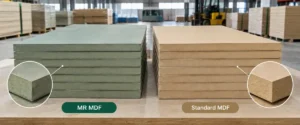
Standard MDF is more sensitive to moisture exposure. Moisture-resistant MDF grades can improve performance in humid interior environments, but buyers should still select the appropriate grade according to the application.
For either material, buyers should check the manufacturer’s technical specifications instead of assuming that every plywood or MDF panel has the same moisture resistance.
Surface Finish and Appearance
MDF has a very smooth and uniform surface, making it particularly suitable for painted furniture. Its consistent structure also helps produce clean edges and detailed profiles during machining.
Furniture plywood offers a different visual advantage. Depending on the face veneer, it can provide a natural wood appearance that is desirable for cabinets, tables, shelving, and other furniture products.
Decorative plywood can further expand the available surface options. Buyers can compare different surface choices in our guide to Fancy Plywood for Furniture.
Machining and CNC Processing
Both materials can be processed using modern woodworking equipment, but their characteristics differ.
MDF is widely used for CNC routing because its uniform fiber structure allows manufacturers to create profiles, grooves, decorative edges, and other detailed shapes.
Furniture plywood can also be CNC machined and is often preferred when the finished component needs a combination of machining performance and structural strength.
The best choice therefore depends on the design, cutting method, thickness, and required finished performance.
Which Is Better for Different Furniture Applications?
There is no single answer to the question of whether plywood or MDF is better.
Choose furniture plywood when you need:
- Higher structural strength
- Good screw-holding performance
- Better resistance to mechanical stress
- A natural wood appearance
- Stronger components for demanding furniture applications
Choose MDF when you need:
- A very smooth surface
- Consistent panel structure
- Easy painting and finishing
- Detailed CNC routing
- Decorative or interior furniture components
For some furniture projects, manufacturers may use both materials. For example, plywood can be used for cabinet structures while MDF is selected for painted doors or decorative components.
Furniture Plywood vs MDF: What Should Buyers Check?
Before placing an order, B2B buyers should evaluate more than the material name. Important specifications include:
- Panel thickness
- Core or fiber structure
- Density
- Surface quality
- Glue or resin system
- Moisture resistance
- Formaldehyde or emission requirements
- Flatness and dimensional stability
- Machining requirements
- Surface finishing
- Application environment
Buyers should also consider whether the panel will be painted, laminated, veneered, CNC machined, or used as a structural component.
Conclusion
The choice between furniture plywood and MDF depends on the specific requirements of the furniture project. Furniture plywood is often preferred when strength, structural performance, screw holding, and natural wood appearance are important. MDF is a strong option when manufacturers prioritize a smooth surface, painting, uniformity, and detailed machining.
For B2B furniture manufacturers, the best approach is to evaluate the panel’s thickness, grade, core or fiber structure, glue system, moisture requirements, surface finish, and intended application before making a purchasing decision.
If you are sourcing furniture plywood for cabinets, shelving, tables, wardrobes, or other furniture applications, contact HuixinWood to discuss suitable plywood specifications for your project.