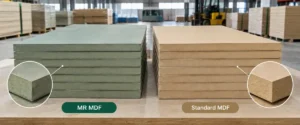
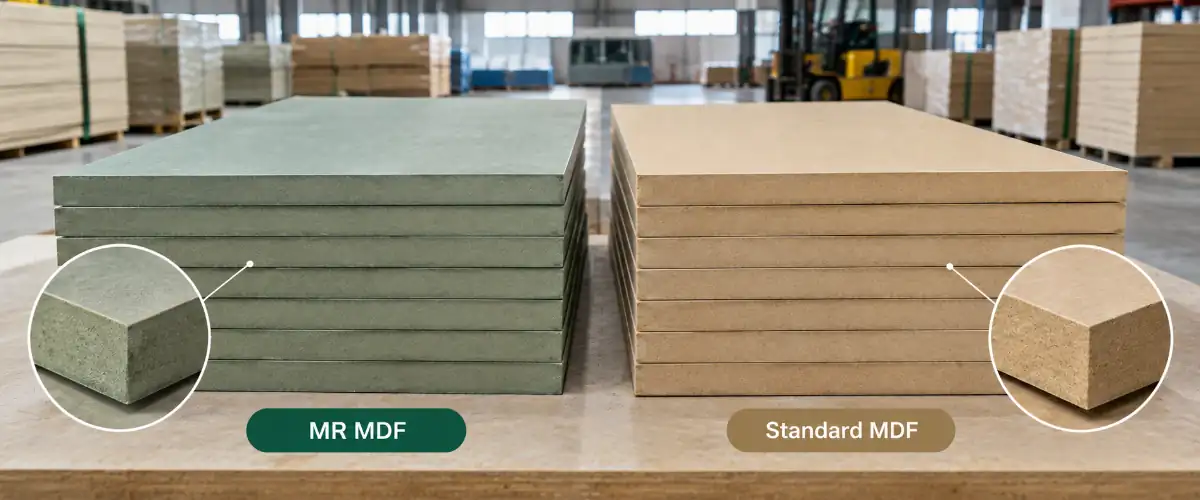
When sourcing MDF for furniture, cabinetry, interior fit-out, or other manufacturing projects, buyers may need to choose between MR MDF and standard MDF. The main difference is not the basic MDF structure, but how the board performs when exposed to humidity. Understanding the difference between MR MDF vs Standard MDF can help importers, distributors, and manufacturers select the right panel for each application.
Both products provide a smooth surface, consistent density, and good machinability. However, their moisture resistance, suitable environments, and purchasing requirements are different.
What Is Standard MDF?
Standard MDF is a general-purpose engineered wood panel designed primarily for dry indoor applications. It is manufactured from refined wood fibers bonded with resin and compressed under heat and pressure.
Its smooth and uniform surface makes standard MDF suitable for furniture, cabinets, shelving, decorative panels, interior doors, and other applications where moisture exposure is limited.
For buyers who want a broader overview of MDF structure, manufacturing, specifications, and applications, see our MDF board buying guide.
What Is MR MDF?
MR MDF means Moisture Resistant MDF. It is manufactured with moisture-resistant additives that improve its performance in environments where humidity or occasional moisture exposure may occur.
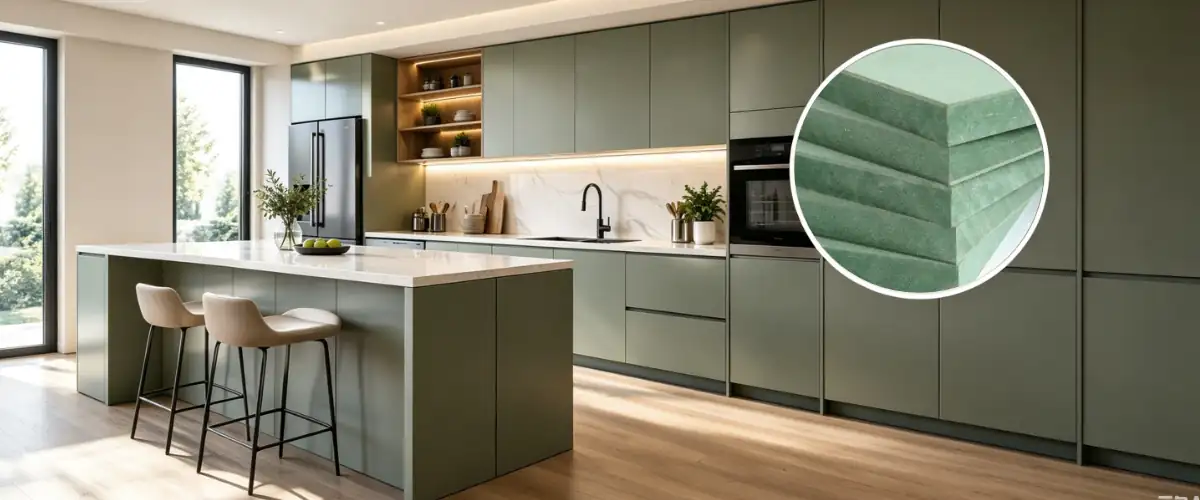
MR MDF is commonly considered for kitchen furniture, bathroom furniture, commercial interiors, and other indoor applications where standard MDF may require additional protection.
However, moisture resistant does not mean waterproof. MR MDF should not be treated as a panel for continuous water exposure or applications where the board is regularly submerged.
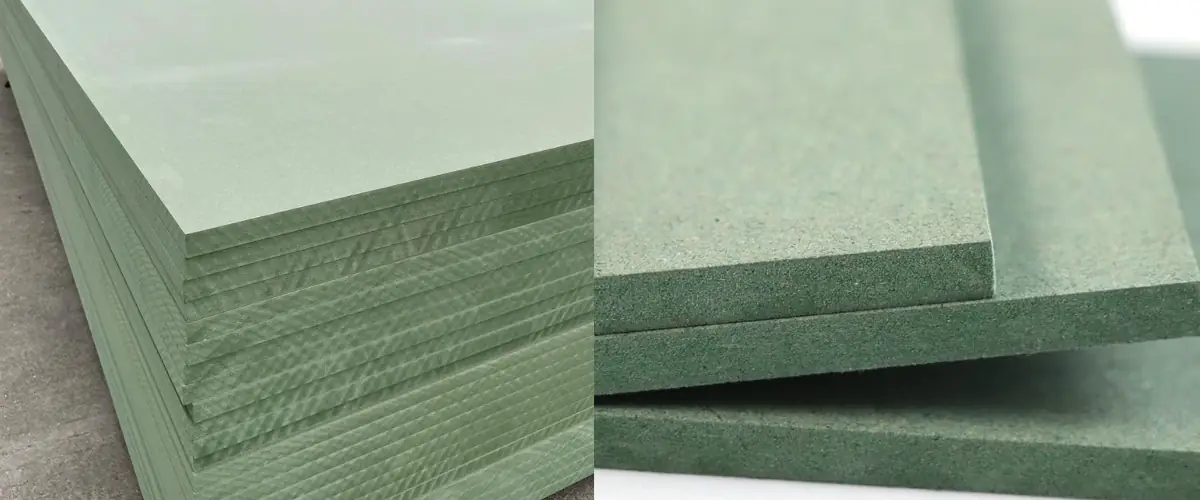
MR MDF vs Standard MDF: Key Differences
| Factor | MR MDF | Standard MDF |
|---|---|---|
| Moisture resistance | Higher | Standard |
| Typical environment | Humid indoor areas | Dry indoor areas |
| Dimensional stability under humidity | Better suited to occasional moisture exposure | More sensitive to moisture |
| Surface quality | Smooth and uniform | Smooth and uniform |
| Machining | Suitable for cutting, drilling and routing | Suitable for cutting, drilling and routing |
| Typical applications | Kitchens, bathrooms, furniture and interior fit-outs | Furniture, cabinets, shelving and decoration |
| Waterproof | No | No |
Moisture Resistance and Dimensional Stability
The most important difference between MR MDF and standard MDF is their response to humid conditions.
Standard MDF is generally intended for dry interior environments. If it is repeatedly exposed to moisture, the board can absorb water, which may affect its dimensions, surface condition, and long-term performance.
MR MDF is formulated to provide improved resistance to moisture. This makes it more suitable for projects where humidity levels may fluctuate or where occasional moisture exposure is possible.
For B2B buyers, the important point is to match the board specification with the actual environment rather than selecting MR MDF simply because it is a higher-specification product.
MR MDF vs Standard MDF: Applications
Where Standard MDF Is Commonly Used
- Furniture manufacturing
- Cabinet components
- Wardrobes
- Shelving
- Interior decorative panels
- Interior doors
- Retail and display fixtures
These applications are generally located in controlled indoor environments where prolonged moisture exposure is not expected.
Where MR MDF Can Be Considered
- Kitchen cabinets and furniture
- Bathroom furniture
- Humid indoor environments
- Commercial interior projects
- Interior fit-out applications with higher humidity
MR MDF can provide an additional level of moisture resistance where the application requires it, but project specifications should always define the required performance level.
What Should B2B Buyers Check?
When comparing MR MDF and standard MDF, moisture resistance is only one part of the purchasing decision. Buyers should also confirm the complete technical specification before placing a bulk order.
- Thickness: Confirm the required thickness and allowable tolerance.
- Density: Check whether the density matches the intended application and processing requirements.
- Formaldehyde emission: Confirm the required emission class and applicable market standard.
- Panel size: Specify standard or custom dimensions according to production requirements.
- Surface quality: Check sanding quality and suitability for painting, veneering or lamination.
- Moisture resistance: For MR MDF, confirm the relevant technical requirements and test documentation.
- Packaging: Make sure the packing method is suitable for container shipping and long-distance transportation.
Formaldehyde requirements should also be considered separately from moisture resistance. Our guide to MDF formaldehyde grades explains the differences between E0, E1, and E2 and why emission requirements should be checked according to the target market.
Which MDF Should B2B Buyers Choose?
The choice between MR MDF and standard MDF should be based on the application rather than a simple preference for one product.
Standard MDF may be suitable when:
- The project is located in a dry indoor environment.
- Moisture exposure is limited.
- The required application does not need enhanced moisture resistance.
- The buyer wants a general-purpose MDF specification.
MR MDF may be considered when:
- The application is exposed to higher indoor humidity.
- The project involves kitchens or bathrooms.
- Better resistance to occasional moisture exposure is required.
- Improved dimensional stability under humid conditions is part of the project specification.
How to Source MR MDF or Standard MDF
For importers and furniture manufacturers, supplier evaluation should go beyond the product name. Before placing a bulk order, ask the supplier for technical specifications, available thicknesses, panel sizes, emission grades, moisture-resistance information, quality-control procedures, and relevant test reports.
It is also useful to request samples before confirming a large order. A sample can help buyers evaluate surface quality, machining performance, thickness consistency, and compatibility with their production process.
HuixinWood supplies a range of wood-based panels, including MDF, plywood, OSB, veneer, and other panel products. The company states that its production base is located in Linyi, Shandong, one of China’s major plywood manufacturing areas. View HuixinWood’s wood panel product range to compare available materials and specifications.
Conclusion
Understanding MR MDF vs Standard MDF helps B2B buyers match MDF specifications with actual project conditions. Standard MDF is generally suitable for dry indoor applications, while MR MDF is designed for environments where higher humidity or occasional moisture exposure needs to be considered.
Before purchasing, buyers should compare moisture resistance together with thickness, density, formaldehyde emission, surface quality, dimensions, and supplier documentation. Selecting the appropriate MDF specification can help manufacturers maintain consistent production quality and reduce material-related problems in large-volume projects.
Contact HuixinWood to discuss MDF specifications, available sizes, samples, and bulk supply requirements for your next project.