Introduction
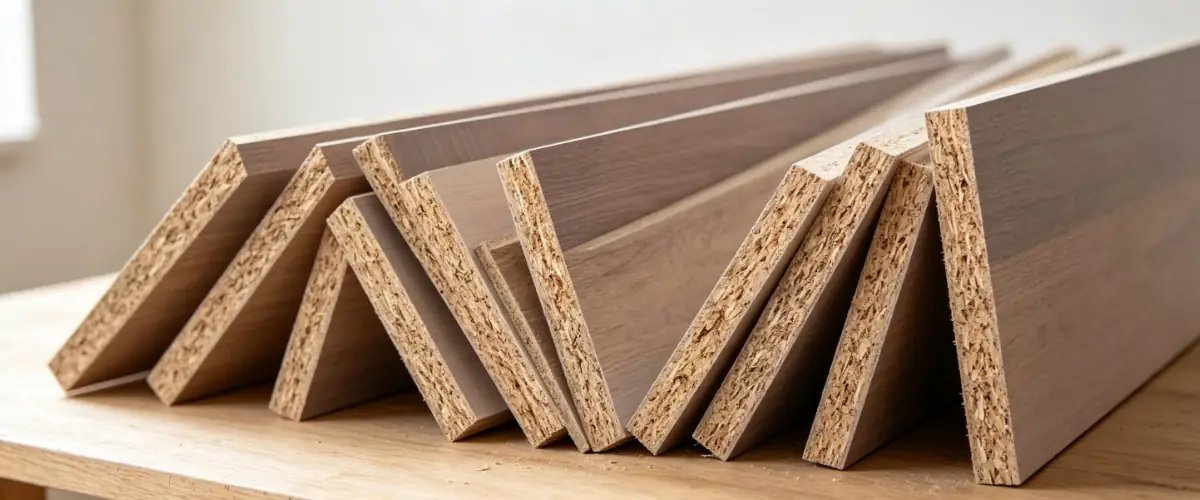
What is chipboard? Chipboard, also known as particle board, is an engineered wood panel made from wood particles bonded with resin and compressed under controlled heat and pressure. It is widely used in furniture manufacturing, cabinetry, shelving, and interior decoration because of its consistent performance and cost efficiency.
For furniture manufacturers, importers, and distributors, understanding chipboard types, grades, uses, and quality factors helps when selecting the right panel. This guide explains how chipboard is made, the main types and applications, how it compares with MDF and plywood, and what buyers should consider when sourcing it.
What Is Chipboard (Particle Board)?
Chipboard is a wood-based panel made by combining wood particles such as chips, flakes, shavings, and sawdust with resin adhesives. The mixture is formed into a mat and compressed under heat and pressure to create a rigid panel.
The term chipboard is more common in Europe and the UK, while particle board is widely used in North America and international markets. In most commercial applications, both terms refer to the same general type of engineered wood panel.
Compared with solid wood, chipboard provides consistent dimensions, relatively uniform density, and good cost efficiency. It can be manufactured in different thicknesses, surface finishes, and performance grades for specific applications.
How Is Chipboard Made?
Understanding what is chipboard and how it is made helps buyers better evaluate panel quality. The basic manufacturing process includes four main stages.
1. Raw Material Preparation
Wood logs, processing residues, recycled wood, or other suitable materials are processed into wood particles of controlled size.
2. Drying and Resin Blending
The particles are dried to suitable moisture conditions and mixed with resin adhesives and additives such as wax where required.
3. Mat Forming and Hot Pressing
The coated particles are distributed into a controlled mat and compressed under heat and pressure. The resin cures and bonds the particles together to form the panel.
4. Finishing and Inspection
Panels are cooled, trimmed, and sanded where required. Manufacturers may inspect thickness, density, moisture content, surface quality, internal bond strength, and formaldehyde emissions.
Types of Chipboard
Different chipboard types are available according to surface finish, structure, and performance requirements.
Raw Chipboard
Raw chipboard has an unfinished sanded surface and is mainly used as a substrate for lamination, veneering, painting, and other decorative treatments.
It is suitable for applications where the panel surface will be covered by another material.
Melamine Faced Chipboard
Melamine faced chipboard, or MFC, consists of a chipboard core covered with decorative melamine-impregnated paper.
It is available in various colors, woodgrain patterns, and textures and is widely used for wardrobes, kitchen cabinets, office furniture, desks, shelving, and ready-to-assemble furniture.
MFC combines a decorative appearance, easy maintenance, and cost efficiency, making it a popular choice for large-scale furniture production.
Veneered Chipboard
Veneered chipboard has a thin layer of natural wood veneer applied to the surface. It provides a more natural wood appearance while retaining the cost advantages of a particle board core.
It is commonly used for furniture, cabinetry, wall panels, and interior joinery.
HPL-Faced Chipboard
HPL-faced chipboard uses high-pressure laminate as the decorative surface. It provides a durable finish for applications exposed to everyday wear.
It can be used for work surfaces, commercial furniture, desks, and other interior applications.
Moisture-Resistant Chipboard
Moisture-resistant chipboard is designed to provide better dimensional stability under humid conditions than standard chipboard.
It can be used for selected kitchen, bathroom, and interior applications. However, moisture-resistant chipboard is not waterproof and should not be exposed to prolonged direct contact with water.
Chipboard vs MDF vs Plywood
Understanding the differences between chipboard, MDF, and plywood helps buyers choose the appropriate panel for their project.
| Feature | Chipboard | MDF | Plywood |
|---|---|---|---|
| Typical Cost | Generally lower | Moderate | Generally higher |
| Structure | Wood particles | Wood fibers | Cross-laminated veneers |
| Surface | Smooth | Very smooth | Good, depending on face |
| Strength | Moderate | Moderate to high | Generally high |
| Screw Holding | Moderate | Good | Generally excellent |
| Machinability | Good | Excellent | Good |
| Moisture Performance | Grade dependent | Grade dependent | Grade and glue dependent |
| Common Uses | Furniture, cabinets, shelving | Doors, furniture, CNC work | Structural and demanding applications |
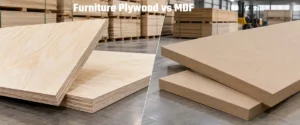
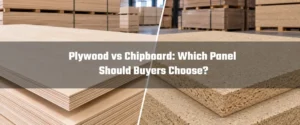
Chipboard is often preferred when cost efficiency, consistent dimensions, and decorative finishing are important. MDF is generally better for detailed machining and very smooth painted surfaces, while plywood is more suitable for demanding structural applications.
Common Applications of Chipboard
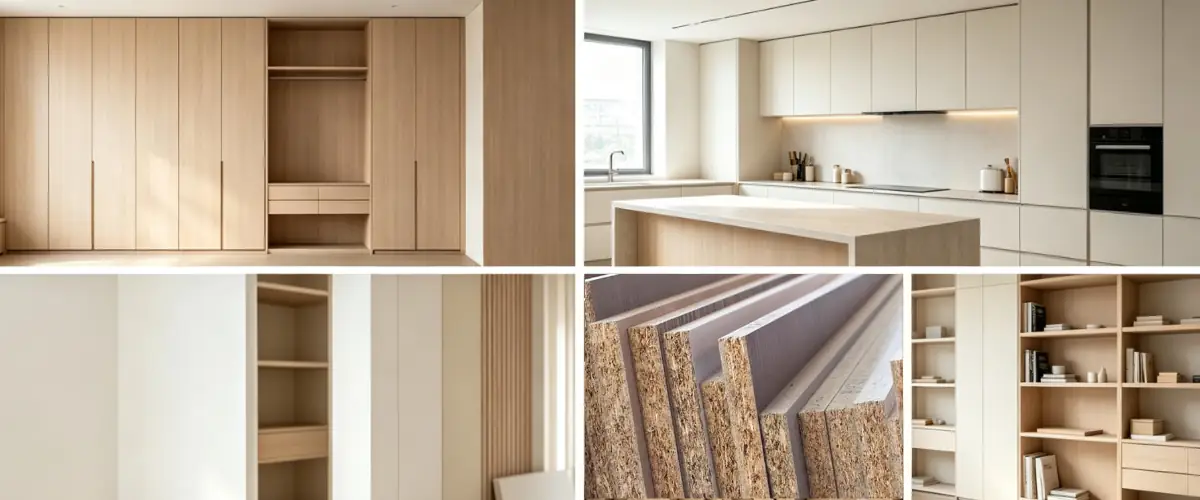
Furniture Manufacturing
Furniture is one of the most common chipboard uses. It is widely used for wardrobes, cabinets, desks, bookshelves, beds, storage units, and flat-pack furniture.
Melamine faced chipboard is especially popular because its decorative surface requires little additional finishing.
Kitchen Cabinets
Melamine faced and moisture-resistant chipboard can be used for kitchen cabinet components when properly specified and protected from direct water exposure.
Its combination of appearance, easy maintenance, and competitive cost makes it suitable for large-scale cabinet production.
Interior Decoration
Chipboard can be used as a substrate for wall panels, partitions, decorative furniture components, and interior joinery. Veneer, melamine, laminate, and other finishes can be selected according to project requirements.
Shelving and Storage
Chipboard is commonly used for shelves and storage systems because of its consistent dimensions and cost efficiency. Thickness, span, density, and expected load should be considered to reduce long-term sagging.
Chipboard Grades and Formaldehyde Emissions
Formaldehyde emissions are an important consideration when purchasing chipboard for furniture and interior applications.
Buyers may encounter classifications such as E0, E1, and E2, particularly in markets where these classifications are commonly used. However, exact emission limits and testing methods vary according to the applicable country, standard, and product category.
| Classification | General Description |
|---|---|
| E0 | Very low emission classification in applicable systems |
| E1 | Low-emission classification commonly specified for indoor applications |
| E2 | Higher emission classification where this category is recognized |
For international sourcing, buyers should specify the required emission standard and testing method rather than relying only on an E0, E1, or E2 label.
Depending on the destination market, buyers may also request FSC documentation, formaldehyde emission reports, CARB-related documents, CE documentation, or other applicable certifications.
How to Choose Quality Chipboard
When comparing chipboard suppliers, price should not be the only consideration. Key quality factors include:
1. Density
Density affects strength, screw holding, machining, and dimensional stability. Ask for the specified density of the exact product rather than relying on a general industry range.
2. Surface Quality
The panel should have a flat, smooth, and consistent surface. Poor surface quality can cause problems during melamine lamination, veneering, painting, or HPL application.
3. Thickness Tolerance
Consistent thickness is important for furniture assembly, CNC machining, and edge banding. Ask for the specified tolerance of the product being purchased.
4. Moisture and Emissions
Moisture content affects dimensional stability, while formaldehyde emissions are important for indoor applications. Request product specifications and relevant test reports.
Proper packaging and storage are also important because chipboard can absorb moisture during transportation.
5. Certifications and Documentation
Depending on the destination market, buyers may require FSC documentation, formaldehyde emission reports, CARB-related documents, CE documentation, or product technical data sheets.
Always confirm that the documentation corresponds to the actual product being supplied.
Standard Chipboard Sizes and Thickness
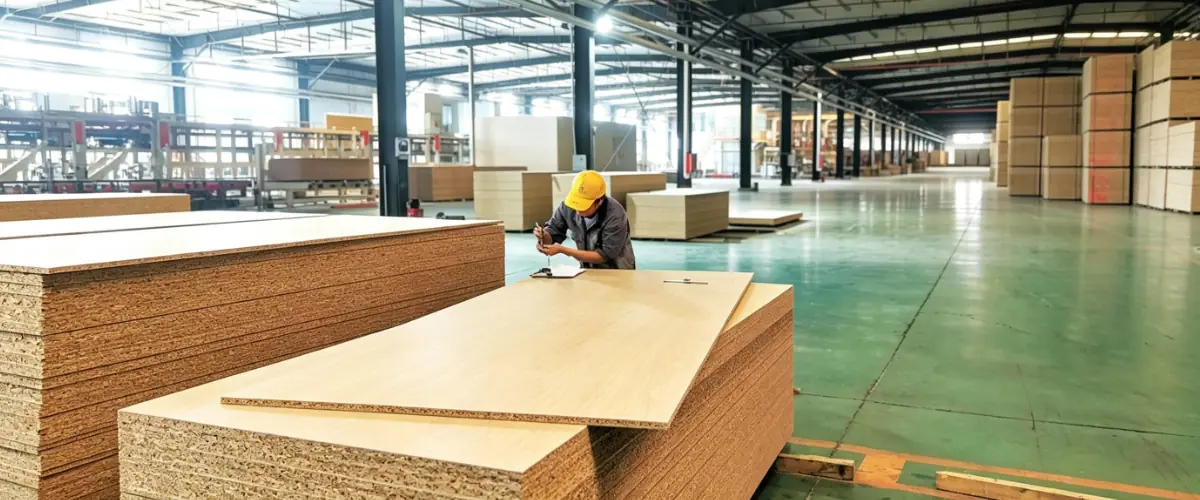
Chipboard is available in different sizes and thicknesses depending on the manufacturer and product grade.
| Specification | Common Options |
|---|---|
| Thickness | 6, 9, 12, 15, 16, 18, 22 mm and customized options |
| Panel Size | 1220 × 2440 mm, 1250 × 2500 mm, or customized |
| Surface | Raw, melamine, veneer, laminate, HPL |
| Emission Class | E0, E1, E2 or market-specific requirements |
| Density | Based on product specification |
For furniture manufacturing, 15–18 mm chipboard is commonly used for cabinets, wardrobes, desks, and shelving. Thinner panels can be used for backs and drawer bottoms, while thicker panels may be selected for work surfaces or applications requiring greater rigidity.
The appropriate thickness depends on panel span, expected load, support structure, and furniture design.
Conclusion
Understanding what is chipboard and how it differs from other engineered wood panels can help buyers make more informed sourcing decisions. Chipboard is a cost-efficient material widely used in furniture, cabinetry, shelving, and interior applications because of its consistent dimensions and flexible surface options.
When selecting chipboard, buyers should consider density, surface quality, thickness, moisture performance, emission requirements, and certifications. The appropriate specifications should always be matched to the application and target market.
For furniture manufacturers, importers, and distributors, working with a reliable chipboard manufacturer and supplier can help ensure consistent quality, proper documentation, and customized specifications.
If you are sourcing chipboard for furniture, cabinetry, or interior projects, HuixinWood can provide customized sizes, thicknesses, surface finishes, and emission grades according to project requirements. Contact us for product specifications, samples, and a quotation.