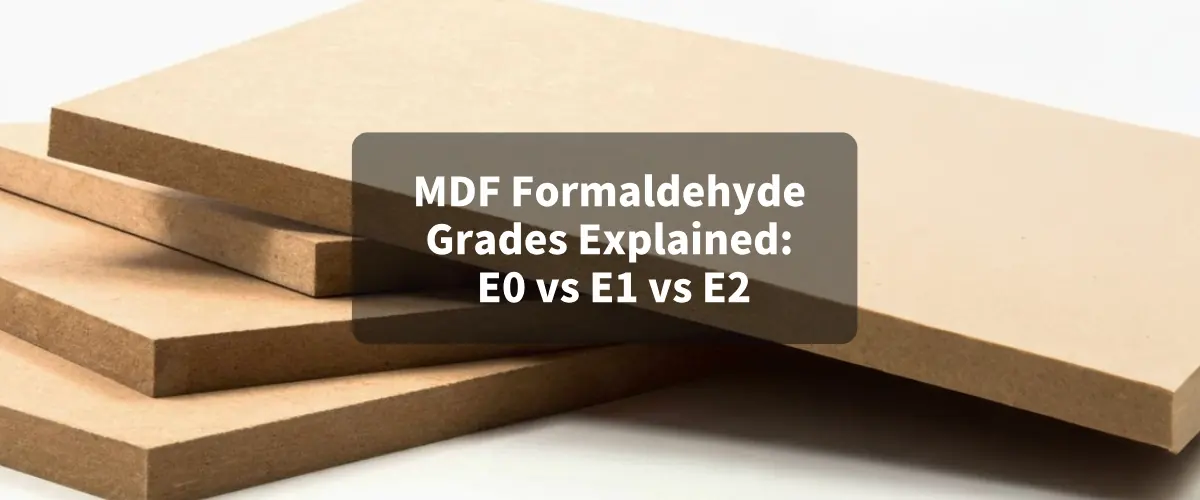
MDF Formaldehyde Grades are one of the most important specifications to consider when purchasing MDF boards, often even more important than thickness or density. Understanding these emission grades helps buyers select safer, more environmentally friendly, and regulation-compliant panels.
Whether you’re manufacturing furniture, importing MDF panels, or selecting materials for interior decoration, knowing the differences between E0, E1, and E2 MDF can help you make the right purchasing decision.
This guide explains MDF Formaldehyde Grades, including E0, E1, and E2, their emission limits, applications, international standards, and how to choose the right grade for your project.
What Is Formaldehyde in MDF?
Medium Density Fiberboard (MDF) is manufactured by compressing wood fibers together using synthetic resin adhesives under high temperature and pressure.
Many traditional adhesives contain urea-formaldehyde (UF) resin, which may release small amounts of formaldehyde over time.
Formaldehyde emissions are measured to classify MDF into different environmental grades.
Lower emissions generally mean:
- Better indoor air quality
- Safer living environments
- Easier compliance with international regulations
- Higher product value
What Are MDF Formaldehyde Grades?
The three most common grades are:
- E0
- E1
- E2
These grades represent the maximum amount of formaldehyde released from MDF boards.
| Grade | Formaldehyde Emission | Environmental Level | Typical Use |
|---|---|---|---|
| E0 | ≤0.5 mg/L | Very Low | Children’s furniture, hospitals, schools |
| E1 | ≤1.5 mg/L | Low | Furniture, cabinets, interior decoration |
| E2 | ≤5.0 mg/L | Higher | Industrial applications only |
Although testing standards vary slightly by country, the lower the number, the lower the emission.
E0 MDF Explained
What Is E0 MDF?
E0 MDF has extremely low formaldehyde emissions and is considered one of the safest MDF grades available.
It is manufactured using:
- Low-emission adhesives
- High-quality wood fibers
- Advanced production technology
Many premium furniture manufacturers specify E0 MDF for export markets.
Advantages
- Lowest formaldehyde emission
- Better indoor air quality
- Suitable for children’s rooms
- Premium market positioning
- Meets strict environmental requirements
Typical Applications
- Luxury furniture
- Children’s furniture
- Bedrooms
- Hotels
- Hospitals
- Schools
- Green building projects
E1 MDF Explained
E1 MDF is the most widely used grade worldwide.
It provides an excellent balance between:
- Cost
- Safety
- Performance
Most European furniture manufacturers require at least E1 MDF.
Advantages
- Affordable
- Safe for indoor use
- Excellent machining performance
- Large global availability
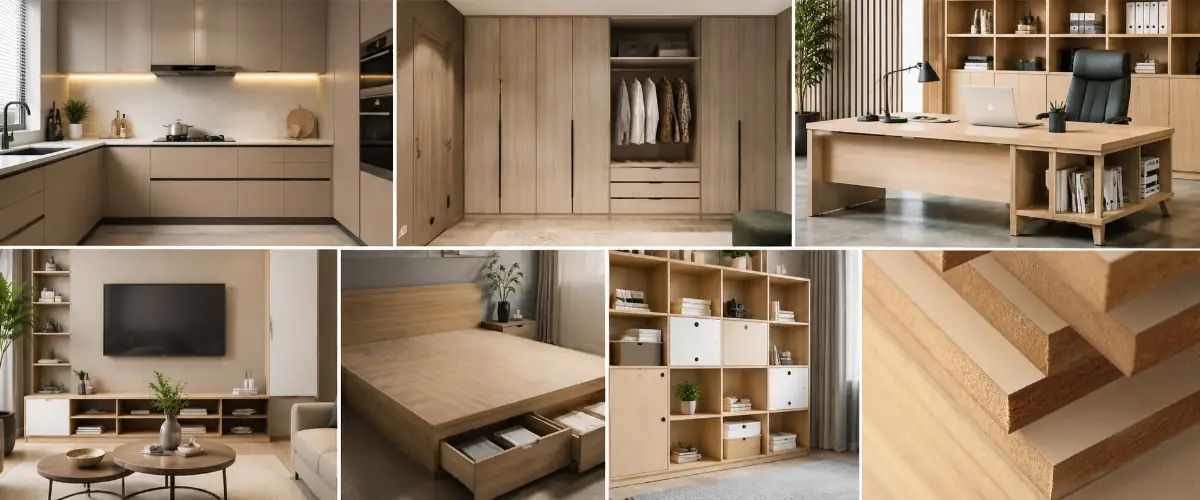
Typical Applications
- Kitchen cabinets
- Office furniture
- Shelving
- Interior wall panels
- Wardrobes
- Commercial furniture
E2 MDF Explained
E2 MDF has a higher formaldehyde emission level.
Although it is still used in some industrial sectors, many countries restrict its indoor residential use.
Typical Applications
- Temporary construction
- Packaging
- Industrial uses
- Outdoor protected applications
For furniture and home decoration, E2 MDF is generally not recommended.
E0 vs E1 vs E2 MDF Comparison
| Feature | E0 | E1 | E2 |
|---|---|---|---|
| Formaldehyde Emission | Lowest | Low | Highest |
| Indoor Furniture | Excellent | Excellent | Limited |
| Children’s Furniture | Yes | Yes | No |
| Export Compliance | Excellent | Good | Poor |
| Environmental Rating | ★★★★★ | ★★★★☆ | ★★☆☆☆ |
| Price | Highest | Medium | Lowest |
Which MDF Grade Is Best?
The best choice depends on your application.
Choose E0 MDF if you need:
- Premium furniture
- Children’s products
- Luxury interiors
- Green building certification
- LEED projects
Choose E1 MDF if you need:
- Standard furniture production
- Office furniture
- Cabinets
- Interior decoration
- Export to Europe
Choose E2 MDF if:
- Budget is the main concern
- Indoor air quality is not critical
- Local regulations allow it
International MDF Emission Standards
Different countries use different standards.
| Region | Standard |
|---|---|
| Europe | E1 (EN 13986 / EN 717-1) |
| United States | EPA TSCA Title VI |
| California | CARB Phase 2 |
| Japan | F☆☆☆☆ |
| Australia | AS/NZS 1859 |
| China | GB/T 39600 |
Many modern MDF manufacturers produce boards that meet multiple certifications simultaneously.
Does Lower Formaldehyde Mean Better MDF?
Not necessarily.
Formaldehyde emission is only one indicator of quality.
A high-quality MDF board should also offer:
- Consistent density
- Smooth surface
- Strong internal bond
- Excellent screw holding
- Moisture resistance (if required)
- Stable dimensions
Buyers should evaluate all specifications rather than focusing only on emission grade.
How Is MDF Formaldehyde Tested?
Manufacturers typically test formaldehyde emissions using standardized laboratory methods.
Common testing methods include:
- Desiccator Method
- Chamber Method
- Perforator Method
- Gas Analysis Method
Certified laboratories issue official test reports to verify compliance with national regulations.
How to Choose the Right MDF Grade
Before placing an order, ask your supplier:
- What formaldehyde grade is available?
- Which international standards does it meet?
- Can you provide CARB or EPA certificates?
- Can you provide SGS test reports?
- Is the MDF suitable for indoor furniture?
- What adhesive system is used?
Reliable suppliers should be able to provide complete testing documentation.
Frequently Asked Questions
Is E0 MDF waterproof?
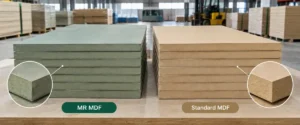
No. Formaldehyde grade only measures emissions. Moisture resistance depends on whether the MDF is standard, MR MDF, or HMR MDF.
Is E1 MDF safe?
Yes. E1 MDF is considered safe for indoor use and complies with most international furniture standards.
Is E0 better than E1?
E0 has lower formaldehyde emissions, making it a preferred choice for premium residential and healthcare applications. However, E1 MDF is sufficient for most furniture and interior projects.
Can E2 MDF be used indoors?
Some regions allow limited indoor use, but many markets discourage or prohibit E2 MDF for residential furniture due to its higher formaldehyde emissions.
Which MDF grade is best for export?
For most export markets:
- Europe: E1 or lower
- North America: CARB Phase 2 or EPA TSCA Title VI compliant
- High-end furniture: E0 or equivalent low-emission MDF
Conclusion
Understanding the differences between E0, E1, and E2 MDF is essential for selecting safe, compliant, and high-quality panels.
While E0 MDF offers the lowest formaldehyde emissions for premium projects, E1 MDF remains the industry standard for most furniture and interior applications. E2 MDF, although less expensive, is increasingly restricted in many markets.
Choosing the appropriate MDF formaldehyde grade not only helps meet environmental regulations but also improves product quality, customer confidence, and long-term market competitiveness.
If you’re looking for a reliable MDF manufacturer and supplier, we offer E0 and E1 MDF boards in a wide range of sizes, thicknesses, and specifications for furniture, interior decoration, and industrial applications. Contact our team today for technical advice, product catalogs, samples, or a free quotation.