What is OSB Board?
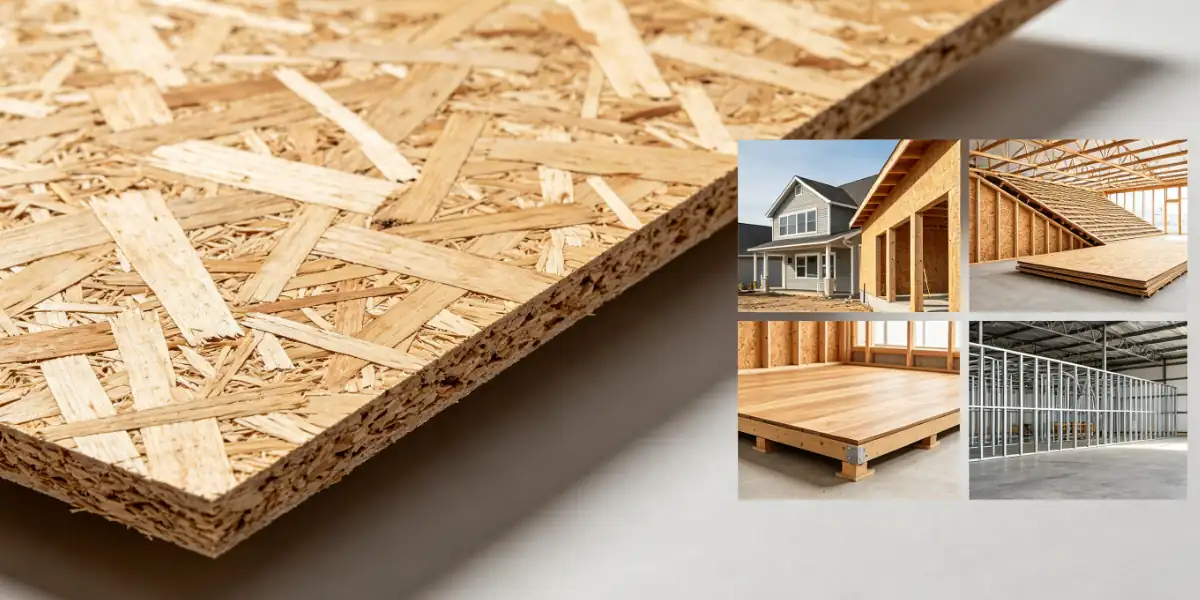
OSB (Oriented Strand Board) is a type of engineered wood panel made by compressing layers of wood strands (flakes) with adhesives under high temperature and pressure. The strands are arranged in specific orientations to improve strength and stability.
It is widely used in construction, flooring, roofing, wall sheathing, and structural applications as a cost-effective alternative to plywood.
Unlike natural solid wood, OSB is manufactured using fast-growing trees and wood residues, making it both efficient and sustainable.
How OSB Board is Made
The manufacturing process of OSB involves several key steps:
- Log Stranding – Wood logs are sliced into thin strands.
- Drying Process – Strands are dried to reduce moisture content.
- Resin Application – Waterproof adhesives and wax are applied.
- Layer Orientation – Strands are arranged in cross-oriented layers.
- Hot Pressing – Panels are compressed under high heat and pressure.
- Cutting & Finishing – Boards are trimmed into standard sizes.
This cross-layer structure is what gives OSB its strength and load-bearing capability.
Key Features of OSB Board
OSB boards are widely preferred in modern construction due to the following features:
✔ High Structural Strength
Cross-oriented layers provide excellent load-bearing capacity.
✔ Cost-Effective Material
More affordable than traditional plywood while maintaining good performance.
✔ Large Panel Sizes
Fewer joints, faster installation on construction sites.
✔ Moisture Resistance Options
Special grades (OSB/3, OSB/4) offer improved water resistance.
✔ Eco-Friendly Material
Made from fast-growing trees and wood waste, reducing environmental impact.

Types of OSB Board
OSB boards are classified based on strength and moisture resistance:
OSB/1
- General interior use
- Furniture, packaging
- Not suitable for load-bearing
OSB/2
- Dry environment structural use
- Interior walls and furniture
OSB/3
- Load-bearing use
- Humid environments
- Flooring, roofing, wall sheathing
OSB/4
- Heavy-duty structural use
- High humidity and demanding construction projects
Applications of OSB Board
OSB is widely used in both residential and commercial construction:
Construction Industry
- Wall sheathing
- Roof decking
- Structural framing support
Flooring Systems
- Subfloor panels
- Underlayment for laminate or hardwood flooring
Wall & Roof Sheathing
- Provides rigidity and stability to building structures
Packaging Industry
- Crates and industrial packaging materials
Furniture & Interior Use
- Budget furniture
- Shelving and partitions
OSB Board vs Plywood
| Feature | OSB Board | Plywood |
|---|---|---|
| Cost | Lower | Higher |
| Strength | High (uniform) | High (natural grain) |
| Moisture Resistance | Moderate to high (grade dependent) | Generally better |
| Appearance | Rough surface | Smoother surface |
| Eco-Friendly | More sustainable | Moderate |
👉 Conclusion:
OSB is ideal for structural applications and cost-sensitive projects, while plywood is preferred for visible decorative surfaces.
Advantages of OSB Board
- Strong and durable engineered panel
- Cost-effective alternative to plywood
- Large sheet sizes reduce installation time
- Stable performance in structural applications
- Environmentally sustainable material
- Widely available and standardized
Limitations of OSB Board
Although OSB is highly useful, it has some limitations:
- Not ideal for high-end visible furniture surfaces
- Edges may swell if exposed to water for long periods
- Heavier than plywood in some cases
- Requires proper sealing in outdoor applications
OSB Board in Modern Construction
Today, OSB is a core material in modern building systems, especially in North America and Europe.
It is commonly used in:
- Prefabricated houses
- Timber frame construction
- Modular buildings
- Industrial warehouses
- Residential housing projects
Its combination of strength, affordability, and availability makes it one of the most widely used engineered wood panels in the world.

Installation Tips for OSB Board
To ensure optimal performance:
- Always store panels in a dry environment
- Leave expansion gaps during installation
- Use correct fasteners (nails/screws designed for wood panels)
- Seal edges when used in humid areas
- Install with grain orientation as recommended by manufacturer
Sustainability of OSB
OSB is considered a more sustainable building material compared to solid wood and some other engineered panels.
Reasons include:
- Uses fast-growing trees (aspen, pine, poplar)
- Maximizes wood utilization efficiency
- Reduces waste from timber processing
- Lower environmental footprint in production
Frequently Asked Questions (FAQ)
1. Is OSB stronger than plywood?
OSB and plywood have similar strength, but OSB offers more uniform load distribution.
2. Can OSB be used outdoors?
Yes, but only OSB/3 or OSB/4 grades with proper sealing and protection.
3. Is OSB waterproof?
OSB is water-resistant, not fully waterproof. Long exposure to water should be avoided.
4. What is OSB mainly used for?
It is mainly used for flooring, roofing, wall sheathing, and structural construction.
Conclusion
OSB board (Oriented Strand Board) is a highly efficient structural engineered wood panel widely used in modern construction and flooring systems. Its balance of strength, affordability, and sustainability makes it a preferred choice for builders and manufacturers worldwide.
Whether you are working on residential housing, commercial projects, or industrial construction, OSB provides a reliable and cost-effective solution.
If you are looking for reliable OSB board supply for construction, flooring, or structural applications, feel free to contact us for specifications, pricing, and customization options.